




Model 47132
Problema 1)
> restart;
1a)
> with(geometry):
>
talls:=proc(c,r)
local p;
intersection(p,c,r):
if nops(p)=0 then
print("No es tallen");
elif nops(p)=1 then
print("Es tallen en un punt");
elif nops(p)=2 then
print("Es tallen en dos punts");
end if;
end proc;
>
1b)
> circle(c,[point(A,1,3),2],[x,y]);

> detail(c);






> line(l,2*x-y-1=0,[x,y]);

> detail(l);



> talls(c,l);

1c)
> intersection(p,c,l);
![[l_intersect1_c, l_intersect2_c]](images/examengener18.gif)
> detail(p);





> draw([c(color=blue),l,p[1](color=black),p[2](color=black)]);
![[Maple Plot]](images/examengener24.gif)
Problema 2)
> restart;
> plot(ln(x)-1/4*x,x=0..20);
![[Maple Plot]](images/examengener25.gif)
> sol1:=evalf(fsolve(ln(x)=1/4*x,x=0..4),15);

> sol2:=evalf(fsolve(ln(x)=1/4*x,x=8..10),15);

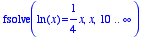
> fsolve(ln(x)=1/4*x,x=10..infinity);
Model 39051
Problema 1)
> restart;
1a)
> with(LinearAlgebra):
>
solucions:=proc(M,k)
local sol;
sol:=LinearSolve(M-k*IdentityMatrix(RowDimension(M)),ZeroMatrix(RowDimension(M),1)):
if IsMatrixShape(sol, zero)=true then
[];
else
sol;
end if;
end proc;






1b)
> M:=<<1|-2|1>,<2|-1|-1>,<-1|2|1>>;
![M := _rtable[4350084]](images/examengener35.gif)
> solucions(M,1);
![_rtable[5129092]](images/examengener36.gif)
> solucions(M,2);
![[]](images/examengener37.gif)
Problema 2)
> restart;
> a:=n->(n^n*sqrt(n))/((n)!*exp(n));

> a(1);

> a(2);

> evalf(a(15));

> l:=limit(a(n),n=infinity);

> with(plots):
Warning, the name changecoords has been redefined
> dib1:=plot(l,x=0..16,colour=green):
> dib2:=plot([seq([n,a(n)],n=1..15)],style=point,colour=blue):
> display([dib1,dib2]);
![[Maple Plot]](images/examengener43.gif)
Model 86183
Problema 1)
> restart;
1a)
>
suc:=proc(n)
local i,a,b;
if n<1 then
print("n ha de ser mÈs gran o igual que 1");
elif n=1 then
a:=10:
else
a:=10:
for i from 2 to n do
b:=(a^2+7)/(2*a):
a:=b:
end do;
end if;
evalf(a,20);
end proc;





> suc(1);

> suc(2);

1b)
> for i from 1 while (evalf(abs(suc(i+1)-suc(i)))>10^(-7)) do
>
i;
end do;
>


> evalf(abs(suc(7+1)-suc(7)),15);

> evalf(suc(8));

> evalf(sqrt(7));

Problema 2)
> restart;
> with(LinearAlgebra):
> M:=<<1|2-a|-2+3*a|2-a+2*a^2>,<2|1+a|-1-2*a|4+a-a^2>,<3|4-a|-4+3*a|6-a+2*a^2>>;
![M := _rtable[4491548]](images/examengener60.gif)
> RowOperation(M,[2,1],-2,inplace);
![_rtable[4491548]](images/examengener61.gif)
> RowOperation(M,[3,1],-3,inplace);
![_rtable[4491548]](images/examengener62.gif)
> RowOperation(M,[3,2],-2/3,inplace);
![_rtable[4491548]](images/examengener63.gif)
> M0:=subs(a=0,M);
![M0 := _rtable[4630212]](images/examengener64.gif)
> LinearSolve(M0[1..3,1..3],M0[1..3,4]);
![_rtable[4789176]](images/examengener65.gif)
Per a=0 es sistema compatible indeterminat
> M1:=subs(a=1,M);
![M1 := _rtable[4761916]](images/examengener66.gif)
> LinearSolve(M1[1..3,1..3],M1[1..3,4]);
Error, (in LinearAlgebra:-LA_Main:-LinearSolve) inconsistent system
Per a=1 es un sistema incompatible
> LinearSolve(M[1..3,1..3],M[1..3,4]);
![_rtable[4916000]](images/examengener67.gif)
Per a<>0 i a<>1 Ès compatible determinat.
Model 30970
Problema 1)
> plot([(ln(x))^4,x],x=0..10,y=0..20);
![[Maple Plot]](images/examengener68.gif)
> sol1:=evalf(fsolve(ln(x)^4=x,x=0..1),15);

> sol2:=evalf(fsolve(ln(x)^4=x,x=3..5),15);

> sol3:=evalf(fsolve(ln(x)^4=x,x=5..10000),15);

> fsolve(ln(x)^4=x,x=5504..infinity);

> plot([(ln(x))^4,x],x=5503..5504);
![[Maple Plot]](images/examengener73.gif)
Problema 2)
> restart;
> with(geometry):
>
configuracio:=proc(P,r,argument)
local l;
if argument<>1 and argument<>-1 then
print("El tercer parametre ha de valer 1 o -1");
elif argument=1 then
PerpendicularLine(l,P,r):
draw([l(color=blue),P,r(color=green)]);
elif argument=-1 then
ParallelLine(l,P,r):
draw([l(color=blue),P,r(color=green)]);
end if;
end proc;







> point(P,3,1);

> detail(P);



> line(r,x-y+2=0,[x,y]);

> detail(r);



> configuracio(P,r,1);
![[Maple Plot]](images/examengener89.gif)
Model 94264
Problema 1)
1a)
> restart;
> with(geometry):
>
talls:=proc(C1,C2)
local In;
if center(C1)=center(C2) and radius(C1)=radius(C2) then
printf("Les dues circumferencies son la mateixa");
else
intersection(In,C1,C2):
printf("El numero de punts de tall es:");
nops(In);
end if;
end proc;
>






1b)
> point(A,1,3);

> circle(C1,[A,2]);

> circle(C2,x^2+y^2-2*x+2*y-2=0,[x,y]);

> detail(C1); detail(C2);
assume that the names of the horizontal and vertical axes are _x and _y, respectively












> talls(C1,C2);
El n™mero de punts de tall Ès:

1c)
> intersection(In,C1,C2);

> draw([C1(color=blue),C2(color=green),In(color=black)]);
![[Maple Plot]](images/examengener113.gif)
Problema 2)
> restart;
> x:=n->(1/sqrt(n))*(product(2*i,i=1..n)/product(2*i-1,i=1..n));

> limit(x(n),n=infinity);
